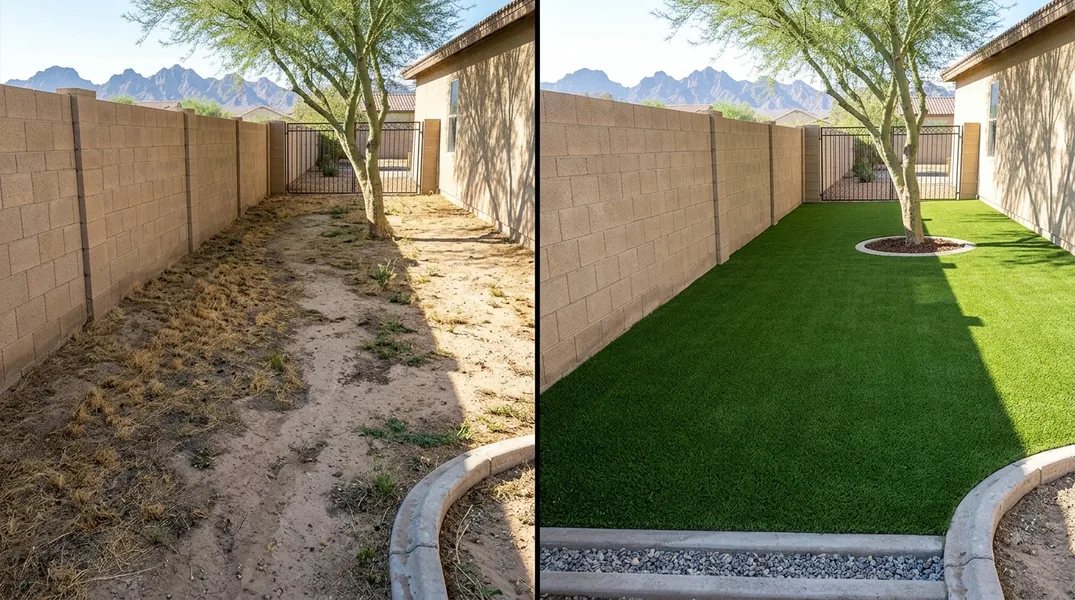
The Yuma Climate Challenge: Why Your Grass Struggles
Living in Yuma means dealing with one of Arizona's most demanding climates. Summer temperatures regularly exceed 110 degrees Fahrenheit, and the intense sun creates conditions that challenge even the most dedicated lawn care enthusiasts. If you've ever watched a natural grass lawn turn brown and brittle during peak summer, you understand the struggle firsthand.
Natural grass in Yuma faces a unique set of obstacles. The region receives minimal rainfall, and the intense UV radiation essentially scorches traditional turf varieties. Homeowners typically face a choice: invest heavily in irrigation and maintenance to keep grass alive during summer, or accept that their lawn will go dormant and unattractive for months. This is where the turf vs artificial grass conversation becomes genuinely practical rather than theoretical.
Understanding Summer Scorch and Winter Rye Overseeding
Many Yuma homeowners with natural lawns resort to winter rye overseeding as a survival strategy. Here's how it works: during late fall, they overseed their dormant summer grass with cool-season rye grass. This keeps the lawn green through winter and early spring, but once temperatures climb again in late May, the rye dies back and the cycle repeats. It's a Band-Aid solution that masks a fundamental problem with growing traditional turf in desert conditions.
Summer scorch occurs because warm-season grasses like Bermuda or St. Augustine simply cannot tolerate prolonged exposure to temperatures above 100 degrees combined with intense sun and low humidity. The grass shuts down, stops growing, and turns brown as a survival mechanism. Winter rye overseeding adds another layer of complexity and expense. You're essentially maintaining two different grass types in one lawn, which means twice the fertilizer applications, more water consumption, and professional expertise to execute properly. For homeowners seeking a simpler, more cost-effective solution, this cycle highlights why artificial grass vs real grass comparisons have become increasingly relevant in the Southwest.
Xeriscaping and Drought-Tolerant Landscaping: The Middle Ground
Before jumping to artificial solutions, some homeowners explore xeriscaping and drought-tolerant landscaping as alternatives. These approaches use native plants, mulch, hardscaping, and minimal turf to create attractive landscapes that require far less water than traditional lawns. Xeriscaping can work beautifully in Yuma, especially if you're willing to embrace a more naturalistic aesthetic featuring desert shrubs, cacti, and gravel beds.
However, xeriscaping has its own limitations. Many homeowners still want the look and feel of a lawn, even if they accept that traditional grass won't thrive. Xeriscaping might eliminate the grass entirely, which isn't appealing to families with children or pets who want a soft play surface. Additionally, establishing native plants still requires initial investment and some ongoing maintenance. If you're seeking a true lawn experience combined with water conservation, drought tolerant landscaping alone may not deliver the full picture. This is where Residential Artificial Grass Installation enters as a practical complement to xeriscaping principles.
Artificial Grass vs Real Grass: The Practical Comparison for Yuma Homeowners
When you compare artificial grass to real grass in Yuma's climate, the numbers tell a compelling story. Real grass demands consistent irrigation, especially during summer months when water costs spike and conservation becomes critical during drought years. Fertilizer applications, weed control, pest management, and seasonal overseeding add up to hundreds of dollars annually. Beyond financial costs, there's the time investment: mowing, edging, and general maintenance consume weekends and energy.
Artificial grass eliminates most of these burdens. It stays green year-round without summer scorch or the need for winter rye overseeding. Water usage drops by up to 80 percent compared to natural turf, making it an environmentally responsible choice in a water-stressed region. Maintenance reduces to occasional brushing and a quick rinse to remove dust. For homeowners tired of the natural grass treadmill, modern artificial turf offers a genuine alternative that looks natural and feels soft underfoot. The initial investment in Residential Artificial Grass Installation is higher than seeding a lawn, but the long-term savings in water, fertilizer, equipment, and labor often justify the upfront cost within five to seven years.
Residential Artificial Grass Installation Cost in Yuma: What to Budget
Understanding the financial commitment is essential when deciding between artificial and real grass. Pricing for Residential Artificial Grass Installation in Yuma typically ranges from $8 to $15 per square foot, depending on the quality of the turf, site preparation requirements, and local labor costs. For an average residential yard of 2,000 square feet, homeowners should budget between $16,000 and $30,000 for a complete installation. While this seems substantial, it's important to contextualize this against ongoing natural grass expenses.
A typical Yuma homeowner with a natural lawn spends $1,500 to $3,000 annually on watering, fertilizer, pest control, equipment maintenance, and occasional professional services. Over a ten-year period, that's $15,000 to $30,000 in recurring costs alone, not counting the value of your time and effort. Artificial grass requires minimal ongoing investment after installation, making it financially competitive with real grass over the long term. Many homeowners also discover that artificial turf increases property appeal and can positively influence resale value. If you're interested in exploring options and understanding how installation costs might apply to your specific property, reach out to Yuma Artificial Grass Installation at (928) 615-6509 for a free estimate.
Making Your Decision: Which Option Fits Your Yuma Home
Choosing between turf and real lawn ultimately depends on your priorities, lifestyle, and long-term vision for your property. If you value convenience, water conservation, and year-round aesthetics, artificial grass delivers on all fronts. If you prefer the tactile experience of natural grass and are willing to invest in irrigation and seasonal maintenance, real grass remains a viable option, though it requires accepting the limitations of desert growing conditions.
Many Yuma homeowners find that a hybrid approach works best: artificial grass in high-traffic areas or where natural grass struggles most, combined with xeriscaping and drought-tolerant plants in other zones. This balanced strategy maximizes usable space while respecting the region's environmental constraints. Whatever you decide, the key is making an informed choice based on your specific needs rather than defaulting to what you might have done in a different climate. If you're ready to explore how Residential Artificial Grass Installation might transform your yard, contact Yuma Artificial Grass Installation today at (928) 615-6509 or visit our website at https://yuma-artificial-grass.com to discuss your project and receive a personalized assessment of your property.
Looking for a professional artificial grass installation company in Yuma? Yuma Artificial Grass Installation responds fast for all your artificial grass installation needs.
Get a Free Quote